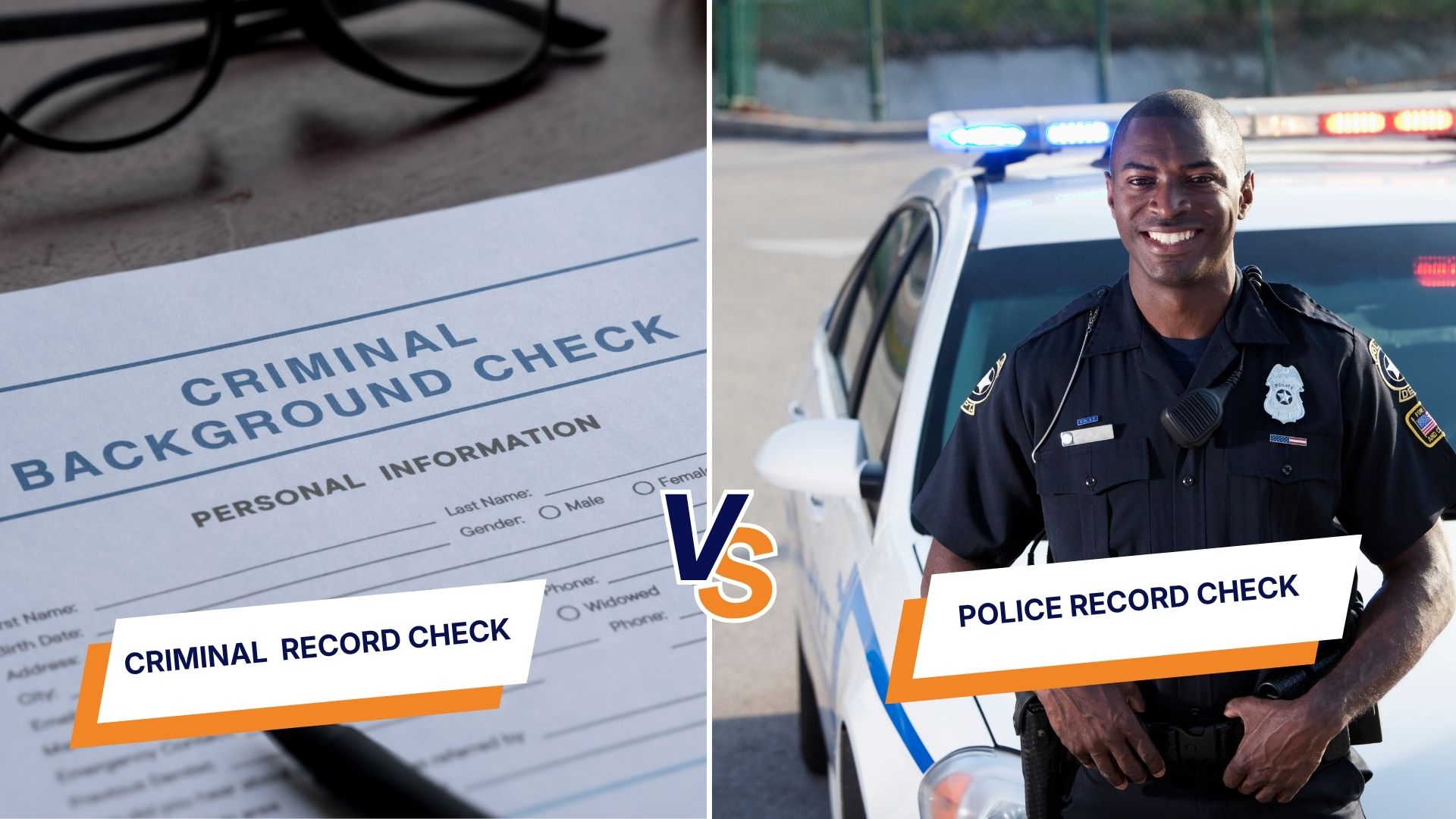


Criminal Record Check vs Police Record Check in Canada: What’s the Difference?

Criminal Record Check vs Police Record Check in Canada: What’s the Difference?

Criminal Record Check vs Police Record Check in Canada: What’s the Difference?

Introduction

Hiring the right person is about much more than finding someone with the right qualifications or a polished résumé. Every hiring decision carries a level of responsibility, whether you’re recruiting for a growing startup, a healthcare organization, a transportation company, or a large enterprise. Employers want confidence that the individual joining their team has accurately represented their background and is suitable for the role.

One area that often creates confusion is the difference between a criminal record check and a police record check. The two terms are frequently used interchangeably across Canada, even though they are not always the same. This misunderstanding can lead employers to request the wrong type of screening, delay recruitment timelines, or create unnecessary compliance challenges.

As Canadian hiring practices continue to evolve, background screening has become a standard part of recruitment rather than an optional step. Organizations are expected to balance candidate experience with due diligence while meeting industry regulations and protecting their workplace. Understanding which type of verification is appropriate is essential for making informed hiring decisions.

Why Background Screening Matters More Than Ever in Canada

Recruitment has changed significantly over the past decade. Remote hiring, digital applications, and increasing workforce mobility have made it easier than ever for employers to connect with talented candidates across Canada. While these changes have expanded access to talent, they have also increased the importance of verifying the information applicants provide during the hiring process.

Today’s employers are expected to make hiring decisions quickly while maintaining high standards of compliance and workplace safety. A résumé and interview may provide valuable insight into a candidate’s experience, but they cannot independently confirm whether employment history, educational qualifications, professional credentials, or criminal history are accurate. This is where structured background screening becomes an essential part of responsible hiring.

Background checks also play an important role in protecting organizations from operational, financial, and reputational risks. Hiring someone without appropriate verification can lead to costly mistakes, particularly in industries where employees handle sensitive information, vulnerable populations, company assets, or regulated responsibilities. A well-designed screening process helps organizations reduce these risks while demonstrating a commitment to governance and workplace integrity.

The growing adoption of digital screening solutions has further transformed how employers approach verification. Instead of relying on lengthy manual processes, organizations can now complete many background screening activities more efficiently while maintaining accuracy and compliance. As a result, criminal background checks, employment verification, education verification, identity verification, and reference checks have become standard components of modern recruitment across many Canadian industries.

Why Employers Conduct Background Screening

Hiring Objective How Background Screening Helps
Reduce hiring risk Confirms information provided by candidates before employment.
Improve workplace safety Identifies records relevant to role-specific hiring decisions.
Support regulatory compliance Meets industry and organizational screening requirements.
Protect company reputation Reduces the likelihood of hiring based on inaccurate information.
Increase hiring confidence Provides verified information to support recruitment decisions.

What Is a Criminal Record Check in Canada?

A criminal record check is one of the most commonly requested background screening services during the hiring process in Canada. Its primary purpose is to determine whether an individual has been convicted of criminal offences that form part of the Canadian Criminal Records Database. Employers, volunteer organizations, licensing bodies, and educational institutions frequently request this verification to support informed decision-making before onboarding a candidate.

Despite its widespread use, a criminal record check is often misunderstood. Many people assume it provides a complete history of every interaction an individual has had with law enforcement. In reality, a standard criminal record check is designed to identify criminal convictions for which a pardon or record suspension has not been granted. Depending on the type of screening requested, it generally does not include outstanding charges, police interactions that did not result in a conviction, or local police occurrence information.

For employers, a criminal record check should never be viewed as a tool to eliminate candidates automatically. Instead, it provides verified information that helps organizations assess whether a particular conviction, if one exists, is relevant to the responsibilities of the position.

Common Situations Where Employers Request a Criminal Record Check

Although every organization develops its own hiring policies, criminal record checks are particularly common in roles involving public trust, financial responsibility, workplace safety, or access to confidential information.

Industries such as healthcare, education, transportation, banking, government, logistics, and security routinely incorporate criminal background checks into their recruitment process. Many private organizations are also expanding background screening programs as part of broader risk management and governance initiatives.

Rather than applying the same screening process to every applicant, employers are increasingly adopting role-based verification strategies. This approach ensures candidates undergo screening that is proportionate to the responsibilities of the position while creating a more consistent and transparent hiring experience.

Roles That Commonly Require Criminal Record Checks

Industry Why Criminal Record Checks Are Requested
Healthcare Protect patients and comply with regulatory standards.
Education Support child safety and institutional policies.
Financial Services Reduce fraud and financial risk.
Transportation Assess suitability for safety-sensitive positions.
Government & Public Sector Meet security and public trust requirements.
Retail & Hospitality Protect assets and customer confidence.
Technology Secure sensitive systems and customer data.

What Is a Police Record Check?

A police record check is a broader screening process administered through authorized police services and accredited providers. Unlike a standard criminal record check, a police record check may include additional information depending on the level of screening requested and the policies of the police service conducting the search.

This distinction is one of the primary reasons employers and applicants often confuse the two terms. While every criminal record check is a type of police-administered verification, not every police record check produces the same information. The content of the report depends on the specific level of screening requested and the purpose for which it is being obtained.

Across Canada, police record checks are commonly categorized into different levels. The most basic level focuses on criminal convictions, while more comprehensive checks may include judicial matters, outstanding charges, peace bonds, or other police information where disclosure is permitted by law. For positions involving children, seniors, or other vulnerable individuals, employers may also require a Vulnerable Sector Check, which follows additional screening procedures established under Canadian legislation.

Because disclosure rules vary across jurisdictions, organizations should avoid assuming that every police record check produces identical results. Selecting the appropriate screening level is essential to ensure compliance with privacy legislation while obtaining information relevant to the responsibilities of the role.

Different Types of Police Record Checks in Canada

Although terminology may vary slightly between provinces and police services, employers generally encounter three common categories of police screening. Understanding when each type should be requested helps organizations remain compliant while ensuring candidates undergo only the level of verification appropriate for their role.

Type of Police Record Check Typical Purpose
Criminal Record Check Standard employment and general hiring requirements.
Criminal Record & Judicial Matters Check Positions requiring additional judicial information.
Vulnerable Sector Check Roles involving children, seniors, healthcare, education, and vulnerable populations.

Criminal Record Check vs Police Record Check: Understanding the Key Differences

Although the terms criminal record check and police record check are often used interchangeably across Canada, they are not identical. The distinction is subtle but important, particularly for employers responsible for making informed hiring decisions. Choosing the appropriate screening type ensures organizations receive the information they genuinely need while respecting Canadian privacy legislation and avoiding unnecessary delays in the recruitment process.

The easiest way to understand the difference is to think of a criminal record check as a specific type of screening, while a police record check is a broader category that can include different levels of verification depending on the purpose of the request. A standard criminal record check primarily confirms whether an individual has criminal convictions that are eligible for disclosure. A police record check, however, may include additional information such as judicial matters or other police records when legally permitted and relevant to the position.

For employers, selecting the wrong screening level can create unnecessary complications. Requesting more information than a position requires may affect candidate experience and raise privacy concerns. On the other hand, requesting a screening level that is too limited could leave important role-specific risks unidentified. Establishing a clear background screening policy helps organizations maintain consistency while ensuring every candidate is assessed fairly.

Rather than viewing one check as “better” than the other, employers should focus on selecting the screening process that best aligns with the responsibilities of the role. A customer service representative, an accountant, a commercial driver, and a healthcare professional all carry different responsibilities, and the level of background verification should reflect those differences.

Criminal Record Check vs Police Record Check at a Glance

Criminal Record Check vs Police Record Check in Canada: What’s the Difference?
FeatureCriminal Record CheckPolice Record Check
Primary PurposeVerify criminal convictionsVerify criminal convictions and, depending on the screening level, additional police information
Typical UseGeneral employment screeningEmployment, volunteer positions, licensing, and regulated roles
Information IncludedCriminal convictions eligible for disclosureVaries depending on the type of police record check requested
Suitable ForMost private-sector hiringRoles requiring additional screening or regulatory compliance
Requested ByEmployers, licensing bodies, organizationsEmployers, volunteer organizations, government agencies
Processing MethodThrough authorized providers or police servicesThrough police services or accredited screening providers
Level of ScreeningStandardMultiple screening levels available

Which One Should Employers Choose?

The answer depends entirely on the position being filled rather than a one-size-fits-all approach.

For many private-sector roles, a standard criminal record check provides sufficient information to support responsible hiring decisions. Positions in administration, sales, manufacturing, technology, customer service, and corporate environments typically do not require the more comprehensive screening available through higher-level police record checks.

However, employers hiring for positions involving vulnerable individuals, public trust, financial authority, healthcare, education, childcare, or law enforcement may need additional screening depending on regulatory requirements and organizational policies. In these situations, requesting the appropriate level of police record check helps ensure compliance while protecting both the organization and the communities it serves.

Common Misconceptions About Background Checks

One of the biggest misconceptions among employers is that every police check automatically includes all interactions an individual has had with law enforcement. In reality, Canadian disclosure rules are governed by legislation, police service policies, and the specific type of screening requested. Not every interaction with police appears on every type of record check.

Another common misunderstanding is that a criminal record check determines whether someone is suitable for employment. In practice, background screening provides verified information to support decision-making—it does not replace professional judgment. Employers must always consider the context of the role, applicable employment laws, and organizational policies before making hiring decisions.

It is also worth remembering that background screening is only one part of a comprehensive recruitment process. Interviews, reference verification, employment history, education verification, identity verification, and role-specific assessments all contribute to building a complete picture of a candidate. Organizations that combine these elements are generally better positioned to make confident and informed hiring decisions.

Why Employers Across Canada Are Investing More in Criminal Background Checks

Recruitment has become significantly more complex than it was just a few years ago. Organizations are no longer hiring exclusively from local talent pools, interviews are increasingly conducted online, and candidates frequently apply for positions across provinces and even internationally. While these changes have expanded access to skilled professionals, they have also made it more difficult for employers to independently verify the information provided during the hiring process.

As a result, background screening has evolved from a compliance exercise into a strategic hiring tool. Canadian employers are placing greater emphasis on verifying criminal history, employment records, education, professional credentials, identity, and references before extending a final offer. Rather than slowing recruitment, these verification steps help organizations make informed decisions with greater confidence while reducing avoidable hiring risks.

The growing reliance on digital recruitment has also influenced candidate expectations. Job seekers expect faster hiring processes, while employers continue to face pressure to fill critical positions without compromising due diligence. Modern background screening platforms have helped bridge this gap by enabling organizations to complete verification more efficiently than traditional manual processes, supporting both recruitment speed and hiring quality.

Hiring Risks Are Changing—So Should Verification

Today’s hiring risks are not always obvious during an interview. Candidates may present impressive résumés, strong communication skills, and relevant experience, yet interviews alone cannot confirm whether that information is accurate. Even well-conducted interviews are designed to evaluate personality, technical ability, and cultural fit—not to validate employment history or official records.

This is why many Canadian employers are adopting a layered approach to hiring. Criminal background checks provide one part of the picture, while employment verification confirms work history, education verification validates academic credentials, identity verification helps establish authenticity, and reference checks provide insight into previous workplace performance. Together, these services create a more complete and reliable view of a candidate before employment begins.

The Cost of a Bad Hire Goes Beyond Recruitment

The Cost of a Bad Hire Goes Beyond Recruitment

When people talk about the cost of a bad hire, they often focus on recruitment expenses or the time required to refill a position. In reality, the consequences can be much broader. A hiring decision based on inaccurate or incomplete information can affect team productivity, customer confidence, workplace morale, operational efficiency, and even legal compliance in regulated industries.

For example, an organization hiring someone into a finance role without verifying relevant background information may expose itself to unnecessary financial risk. Similarly, healthcare providers, educational institutions, transportation companies, and organizations serving vulnerable populations often have additional responsibilities to ensure employees meet appropriate screening standards before beginning work.

While background checks cannot predict future behaviour, they provide employers with verified information that supports responsible decision-making. This distinction is important because the goal of background screening is not to disqualify candidates unnecessarily—it is to help employers make hiring decisions based on accurate, verified information rather than assumptions.

Background Screening Benefits for Modern Employers

Business ChallengeHow Background Screening Helps
High-volume recruitmentStreamlines verification without delaying hiring.
Remote hiringConfirms candidate information regardless of location.
Regulatory complianceSupports industry-specific hiring requirements.
Resume inaccuraciesVerifies employment, education, and identity claims.
Workplace safetyProvides relevant screening for safety-sensitive roles.
Brand reputationReduces hiring risks that could impact organizational trust.

Background Screening Is Becoming a Competitive Advantage

Organizations that invest in structured background screening often experience benefits beyond risk reduction. A consistent verification process creates greater confidence among hiring managers, supports fair and transparent recruitment practices, and demonstrates a commitment to responsible employment standards. Candidates also benefit from knowing that hiring decisions are based on verified information rather than assumptions or inconsistent screening practices.

As competition for skilled talent continues to grow across Canada, employers are looking for ways to improve both recruitment efficiency and candidate experience. Digital background screening solutions allow organizations to automate many administrative tasks while maintaining accuracy and compliance. This enables HR teams to spend less time managing paperwork and more time focusing on candidate engagement and strategic workforce planning.

Choosing the Right Background Check for Different Industries in Canada

There is no universal background screening process that applies to every role or every organization. The type of verification an employer requests should always reflect the responsibilities of the position, the level of trust involved, and any industry-specific regulations. While a standard criminal record check may be sufficient for some roles, others require a broader screening strategy that includes employment verification, education verification, identity checks, or professional credential validation.

Canadian employers are increasingly moving away from a “one-size-fits-all” approach to hiring. Instead, they are implementing role-based screening policies that align verification requirements with business risks. This approach not only helps organizations remain compliant but also ensures candidates are screened fairly and consistently throughout the recruitment process.

Choosing the right level of background screening begins with understanding the role itself. A position involving financial transactions, access to confidential information, vulnerable populations, or public safety naturally requires more comprehensive verification than a role with limited operational risk. By tailoring screening requirements to each position, organizations can protect both their business and the candidate experience.

Healthcare and Community Services

Healthcare professionals, caregivers, and employees working with vulnerable individuals are entrusted with significant responsibility every day. Beyond technical qualifications, employers must have confidence that candidates meet the ethical and legal standards expected within the profession.

For these roles, organizations often require more than a standard criminal record check. Depending on provincial requirements and the nature of the position, employers may request a police record check or a Vulnerable Sector Check alongside employment verification and professional credential validation. These additional screening measures help support patient safety, regulatory compliance, and public trust.

Because healthcare recruitment often involves urgent hiring needs, many organizations are also adopting digital screening solutions that streamline verification without compromising accuracy or compliance.

Financial Services and Corporate Leadership

Banks, insurance providers, accounting firms, investment companies, and corporate finance departments operate in environments where integrity and accountability are fundamental. Employees frequently manage confidential financial information, customer records, and sensitive business assets, making background verification an important part of risk management.

A criminal background check is commonly combined with employment verification, education verification, professional credential checks, and reference verification for these positions. Rather than focusing solely on criminal history, employers seek a complete understanding of a candidate’s professional background to support informed hiring decisions.

As financial organizations continue to strengthen governance and compliance frameworks, comprehensive background screening has become an essential component of responsible recruitment.

Transportation, Logistics, and Commercial Driving

The transportation industry presents unique hiring challenges. Commercial drivers, fleet operators, logistics coordinators, and delivery professionals are responsible for public safety, valuable cargo, and regulatory compliance on a daily basis.

In addition to a criminal record check, employers often request a driver abstract to review an applicant’s driving history. This combination provides valuable insight when hiring for safety-sensitive positions and helps organizations meet insurance requirements, fleet management standards, and operational policies.

For employers managing large driver recruitment programs, automated background screening significantly reduces administrative effort while maintaining consistency across every applicant.

Education, Childcare, and Non-Profit Organizations

Schools, childcare centres, youth organizations, and many non-profit institutions have a heightened responsibility to protect the communities they serve. Recruitment decisions within these sectors often require additional levels of due diligence because employees and volunteers regularly interact with children or other vulnerable individuals.

Depending on the position, organizations may require a Vulnerable Sector Check in addition to identity verification and credential validation. Establishing a structured screening process demonstrates a commitment to safeguarding the people who rely on these services while supporting organizational accountability.

Technology Companies and Remote Workforces

Technology companies are hiring talent across provinces, countries, and time zones more than ever before. While remote hiring creates access to a broader talent pool, it also introduces new challenges related to identity verification, employment history, and credential validation.

A structured background screening process helps organizations verify information regardless of where candidates are located. Criminal background checks, identity verification, education verification, and employment verification work together to provide hiring teams with greater confidence before extending an offer.

Staffing Agencies and High-Volume Recruitment

Staffing agencies face a different challenge altogether. Rather than hiring for one position at a time, recruiters often manage multiple vacancies across different industries with tight hiring deadlines. Maintaining consistency while processing large volumes of candidates can become difficult when verification relies on manual workflows.

Automated background screening enables staffing firms to initiate criminal record checks, employment verification, reference checks, and identity verification through a centralized process. This improves turnaround times, reduces administrative workload, and allows recruiters to focus on placing qualified candidates instead of managing paperwork.

Why a Role-Based Screening Strategy Works Best

Organizations that tailor background screening to individual job responsibilities create a hiring process that is both practical and defensible. Instead of applying unnecessary verification to every applicant, employers focus on obtaining information that is genuinely relevant to the position. This balanced approach supports compliance, respects candidate privacy, and helps HR teams make decisions with greater confidence.

As hiring continues to evolve across Canada, role-based verification is becoming a best practice rather than an exception. Employers that invest in structured screening policies are better positioned to reduce hiring risk, improve operational efficiency, and build stronger, more trusted workforces.

Supporting Businesses of Every Size

Background screening is not limited to large enterprises. Small businesses, growing startups, staffing agencies, non-profit organizations, and multinational employers all face hiring decisions that require trust and accountability. The scale may differ, but the need for verified information remains the same.

For startups experiencing rapid growth, efficient verification helps establish professional hiring practices from the beginning. Staffing agencies can process large volumes of candidates more consistently, while established enterprises benefit from standardized screening policies across multiple business units. By adapting to different hiring models, digital background screening supports organizations at every stage of growth.

As workforce mobility continues to increase across Canada, having a flexible and scalable verification process is becoming a competitive advantage rather than simply an operational requirement.

Background Screening Beyond Criminal Record Checks

One of the biggest misconceptions in recruitment is that a criminal record check alone provides a complete picture of a candidate. In reality, effective background screening combines several verification services depending on the responsibilities of the role.

An organization hiring a finance manager may prioritize employment verification and education verification alongside a criminal background check. A logistics company may require a driver abstract in addition to identity verification. A staffing agency recruiting for multiple industries may combine automated reference checks with employment screening to improve recruitment efficiency.

Selecting the right combination of verification services allows employers to build a hiring process that is both thorough and proportionate. Rather than requesting unnecessary information, organizations focus on obtaining the specific verification required for each position, supporting fair recruitment practices while protecting business interests.

Comprehensive Background Screening Services

Verification Service Purpose
Criminal Record Check Verify criminal convictions relevant to employment screening.
Employment Verification Confirm previous work history and employment details.
Education Verification Validate degrees, diplomas, certifications, and institutions.
Reference Verification Obtain structured feedback from previous employers or professional references.
Identity Verification Confirm candidate identity using secure verification methods.
Driver Abstract Checks Review driving history for transportation and fleet roles.
Credential Verification Validate professional licences and industry certifications.
International Background Checks Support hiring candidates with international work or education history.

Building Confidence into Every Hiring Decision

Successful recruitment is not about creating additional barriers for candidates. It is about ensuring that hiring decisions are supported by verified information, consistent processes, and responsible risk management. Employers that invest in structured background screening often experience greater confidence throughout the recruitment process while reducing the likelihood of avoidable hiring issues.

As Canadian workplaces continue to evolve, background screening is becoming an integral part of workforce planning rather than a final administrative step. Organizations that embrace modern verification practices are better equipped to hire confidently, protect their reputation, and create stronger teams built on trust and transparency.

Questions Every Employer Should Ask Before Requesting a Criminal Record Check

Background screening is most effective when it is planned rather than applied as a last-minute hiring requirement. Before requesting any type of criminal record check or police record check, employers should first consider the purpose of the screening and whether it is appropriate for the position. Asking the right questions at the beginning helps organizations create a recruitment process that is fair, compliant, and relevant to the responsibilities of the role.

One of the first considerations is whether the position genuinely requires criminal background screening. Not every role carries the same level of risk, and applying identical screening requirements to every applicant may not always be necessary. Employers should evaluate the responsibilities of the position, the level of access to sensitive information, financial assets, company property, or vulnerable individuals before deciding on the appropriate level of verification.

Another important consideration is determining exactly what information is needed. A standard criminal record check may be sufficient for many private-sector roles, while regulated industries or positions involving public trust may require a police record check or a Vulnerable Sector Check. Understanding these differences helps avoid unnecessary screening requests while ensuring compliance with Canadian employment and privacy legislation.

Organizations should also think beyond criminal history. Hiring decisions are strongest when they are supported by multiple sources of verified information. Employment verification, education verification, identity verification, credential verification, and reference checks all contribute to a more complete understanding of a candidate’s background. Looking at the whole picture allows employers to make balanced decisions based on verified facts rather than isolated data points.

How Credibled Simplifies Background Screening for Canadian Employers

Background screening has traditionally been associated with paperwork, lengthy turnaround times, multiple follow-ups, and disconnected verification processes. HR teams often had to coordinate with several providers to complete criminal record checks, employment verification, education verification, reference checks, and identity validation. While these methods served their purpose, they frequently slowed hiring and increased the administrative workload for recruiters.

Today’s hiring environment demands something different. Organizations are expected to recruit quickly while maintaining high standards of compliance and due diligence. Whether hiring one employee or hundreds of candidates each month, employers need a screening process that is accurate, efficient, and easy to manage.

This shift has led many Canadian organizations to adopt digital background screening platforms that centralize the verification process. Rather than managing multiple vendors or manually tracking each verification request, employers can initiate, monitor, and complete background screening through a single workflow. The result is greater visibility, improved efficiency, and a better experience for both hiring teams and candidates.

Credibled was built with these modern recruitment challenges in mind. Instead of treating background screening as a series of disconnected tasks, the platform brings together multiple verification services into a streamlined process that supports informed hiring decisions without adding unnecessary complexity.

Conclusion

Criminal record checks and police record checks are often spoken about as though they are the same, but understanding the distinction is essential for making informed hiring decisions. While a criminal record check focuses on confirming criminal convictions that are eligible for disclosure, a police record check may provide additional information depending on the level of screening requested and the specific requirements of the role.

The most effective employers are not those who simply perform more background checks—they are the ones who request the right verification for the right position. A thoughtful, role-based approach helps organizations balance candidate experience, regulatory compliance, operational efficiency, and workplace safety without creating unnecessary barriers during recruitment.

As Canadian workplaces become increasingly digital and hiring continues to move faster, background screening is no longer just an administrative task. It has become a strategic component of modern talent acquisition, helping organizations make decisions with greater confidence while protecting their people, customers, and reputation.

Whether you’re hiring your first employee, expanding a national workforce, or managing recruitment across multiple locations, investing in structured background screening helps create a stronger foundation for long-term business success.

Ready to Hire with Confidence?

Choosing the right background screening partner can simplify recruitment while ensuring every hiring decision is supported by verified information.

Credibled provides secure, efficient, and comprehensive background screening solutions for organizations across Canada, including:

  • Criminal Record Checks 
  • Employment Verification 
  • Education Verification 
  • Identity Verification 
  • Reference Verification 
  • Driver Abstract Checks 
  • Credential Verification 
  • International Background Checks 

Whether you’re a startup, staffing agency, enterprise, healthcare provider, educational institution, or nonprofit organization, Credibled helps you build a hiring process that is accurate, compliant, and designed for today’s workforce.

Talk to the Credibled team today to learn how modern background screening can support your recruitment goals.

FAQs

No. A criminal record check verifies criminal convictions that are eligible for disclosure, while a police record check is a broader category that may include additional information depending on the level of screening requested.

Most private-sector employers request a standard criminal record check. Certain regulated industries or roles involving vulnerable individuals may require additional police screening.

A police record check may be appropriate when legislation, organizational policies, or the nature of the role requires a higher level of background screening than a standard criminal record check.

Employers should request background screening that is relevant and proportionate to the responsibilities of the role while complying with applicable employment and privacy legislation.

Depending on the role, employers may also request employment verification, education verification, identity verification, reference checks, credential verification, or driver abstract checks.

Processing times vary depending on the screening method, jurisdiction, and verification requirements. Many modern digital background screening providers offer significantly faster turnaround times than traditional manual processes.

Employment verification confirms a candidate’s work history and complements criminal background screening by providing additional confidence in the information presented during recruitment.

No. Businesses of all sizes, including startups, nonprofits, staffing agencies, and small businesses, benefit from structured background screening when making hiring decisions.

Yes. Digital screening solutions often simplify verification, improve communication, and reduce administrative delays, creating a smoother hiring process for both employers and candidates.

Employers should look for providers that offer secure digital workflows, comprehensive verification services, regulatory compliance, scalable solutions, and responsive customer support tailored to Canadian hiring requirements.

Nonprofit background screening | Credibled